
By Changamire T. D. Mukove-Tholanah, Senior Associate, Madzima & Company Law Chambers
“The liberty of the individual is not a gift of the State; it is the measure by which the State is judged.”
Arrest is the moment at which the citizen meets the full weight of the State. It arrives without ceremony: at a roadblock, in the workplace, at the door before first light. In that moment the arrested person is rarely composed enough to ask what the law permits, what it forbids, and whom it allows them to call.
The Constitution of Zimbabwe answers those questions in advance. Chapter 4, the Declaration of Rights, attaches to every arrested and detained person a body of guarantees that come into being the instant liberty is taken, and that travel with that person from the charge office to the dock. They are not privileges to be earned by good behaviour, nor concessions an investigating officer may withhold. They are rights, enforceable in any court in the land.
What follows sets out those rights in the sequence in which they arise: at the moment of arrest, in custody, at the bail stage and at trial. It closes with practical counsel for the family member who receives the telephone call that no one expects.
I. At the Moment of Arrest
Section 50 of the Constitution is the arrested person’s charter. Its first guarantees take effect immediately, before any question is asked or any statement recorded.
The right to know the reason. An arrested person must be informed, at the time of arrest, of the reason for it. The obligation is contemporaneous. An assurance that matters will be “explained at the station” does not discharge it.
The right to communicate. The arrested person must be permitted, without delay and at the expense of the State, to contact a spouse or partner, a relative, a legal practitioner or any other person of their choosing. They are further entitled, at their own expense, to consult in private with a legal practitioner and a medical practitioner of their choice.
The right to silence. Section 50(4) secures the right to remain silent, the right to be informed promptly of that right and of the consequences of speaking or of remaining silent, and the right not to be compelled to make any confession or admission. Nemo tenetur seipsum accusare: no one is bound to accuse himself. The maxim is centuries old; in Zimbabwe it carries constitutional force.
Counsel’s advice. Offer no physical resistance, however unjust the arrest may appear; its lawfulness is a question for the court, not the roadside. Ask, calmly and clearly, why you are being arrested. Furnish your name and address. Then decline, courteously, to answer further questions or to sign any warned and cautioned statement until you have taken legal advice.
II. In Custody
Dignity is not surrendered at the cell door. Section 53 provides that no person may be subjected to physical or psychological torture, or to cruel, inhuman or degrading treatment or punishment. The prohibition is absolute; no exigency of investigation qualifies it. An admission extracted by force or fear is not merely improper. It is evidence whose admissibility the defence will contest, and which a court may well exclude.
The forty-eight-hour rule. 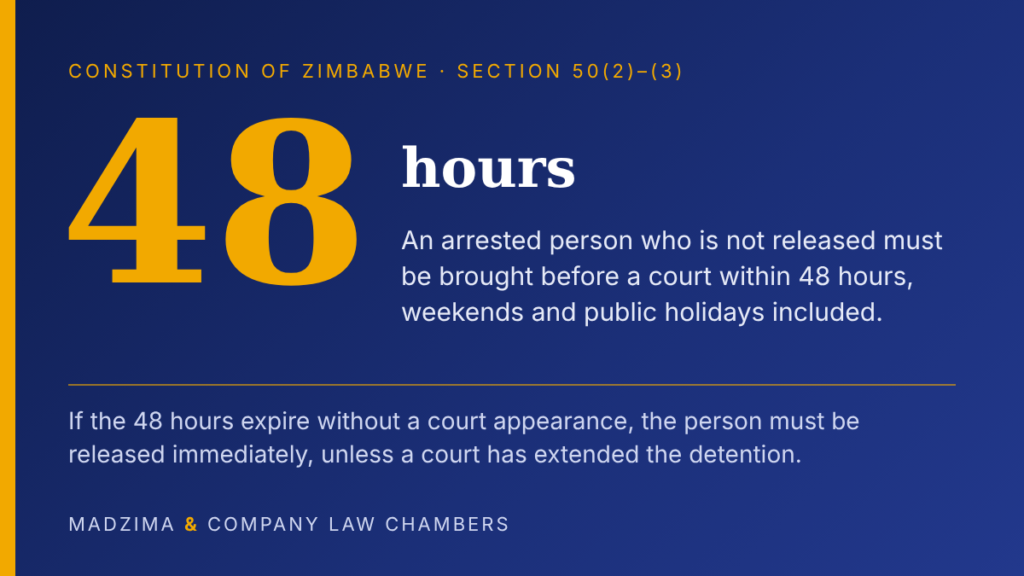 A person who is arrested or detained for an alleged offence, and who is not released, must be brought before a court as soon as possible and in any event not later than forty-eight hours after the arrest (section 50(2)). The period runs through weekends and public holidays alike. Where it expires without the person being brought to court, section 50(3) requires their immediate release, unless a competent court has already extended the detention. The clock is the detainee’s ally; it should be noted from the first minute.
Liberty is the rule; detention the exception. The Constitution contemplates that an arrested person will be released, unconditionally or on reasonable conditions, pending charge or trial, unless compelling reasons justify continued detention. The burden of justification lies with the State, not the citizen.
Against secret detention. Where a person is held unlawfully, or their whereabouts are unknown, any person may approach the High Court for an order that the detainee be produced before it (section 50(7)). This is the ancient writ of habeas corpus, “that you have the body”, which has for centuries stood between the individual and the oubliette. It remains as vital today as when it was first issued.
III. Bail
Bail is too often spoken of as a favour the court bestows. It is nothing of the kind. It is the procedural expression of the presumption of innocence: a person not yet convicted ought not, save for good reason, to be deprived of liberty while the State prepares its case.
The point of departure. Section 117 of the Criminal Procedure and Evidence Act [Chapter 9:07] provides that a person in custody in respect of an offence is entitled to be released on bail, unless the court finds that the interests of justice require detention. Entitlement is the rule; refusal must be justified.
When the interests of justice may require detention. Broadly, where there is a real likelihood that the accused, if released, would:
- fail to stand trial;
- interfere with witnesses or tamper with evidence;
- endanger the safety of the public or commit further offences; or
- otherwise undermine the proper functioning of the criminal justice system.
These are matters of evidence, not assertion. The bare statement that an accused “is likely to abscond” is no substitute for facts, and a court is entitled to say so.
Conditions. Where bail is granted it is ordinarily attended by conditions: a cash deposit, periodic reporting to a police station, surrender of travel documents, residence at a fixed address and a prohibition on contacting State witnesses. Conditions must be proportionate. Where bail is refused, or the terms are oppressive, the refusal may be challenged on appeal, and a fresh application may be brought upon changed circumstances. For certain grave offences, the forum and procedure for bail differ; early advice on the correct route avoids costly delay.
A word on admission-of-guilt fines. For some minor offences, the police may offer release upon payment of an admission-of-guilt fine. The name is accurate: payment is a plea of guilty, and it results in a conviction. A person who disputes the allegation should take advice before paying.
IV. At Trial
Section 69 guarantees every accused person a fair and public trial within a reasonable time before an independent and impartial court. Section 70 gives that promise its content. Among its guarantees, the accused person is entitled:
- to be presumed innocent until proved guilty, the burden of proof resting throughout on the State;
- to be informed promptly of the charge, in sufficient detail to answer it;
- to adequate time and facilities to prepare a defence;
- to be represented by a legal practitioner of their choice, and, where substantial injustice would otherwise result, to have one assigned at the State’s expense;
- to be present at the trial and to challenge the evidence, including by cross-examining the State’s witnesses and adducing evidence in their own defence;
- to remain silent and not to give self-incriminating evidence;
- to an interpreter where they do not understand the language of the proceedings; and
- not to be convicted of conduct that was not an offence when committed, nor tried again for an offence of which they have already been acquitted or convicted.
Audi alteram partem, “let the other side be heard”, is among the oldest precepts of natural justice. Its modern expression in our law is simple: no person is to be condemned unheard, and every person is entitled to be heard through counsel.
V. Counsel for the Family
The call seldom comes to the arrested person’s lawyer first. It comes to a spouse, a parent, a sibling. What is done in the first hours often shapes what follows. We advise:
- Establish where the person is held, and the name or force number of the investigating officer.
- Record the charge precisely as stated.
- Instruct a legal practitioner at once. Early intervention protects against ill-advised statements and brings the bail application forward.
- Note the time of arrest. It is from this moment that the forty-eight hours run.
- Assemble the bail papers: national identity document, proof of residence, particulars of employment or business, and the details of a responsible person who may stand as surety.
- Provide necessities where the station permits: medication, food and warm clothing.
- Say nothing about the facts of the matter by telephone or on social media, and make no approach to witnesses or the complainant, however well-intentioned.
- Retain every receipt for monies paid to the police or the court, including bail deposits, for their later recovery.
Where private representation is beyond the family’s means, the Legal Aid Directorate may be approached for assistance.
Conclusion
A right unknown is a right unexercised, and a right unexercised is, in practical terms, no right at all. The Declaration of Rights stands guard from the moment of arrest, but it does its finest work when a practitioner is at hand to invoke it: to insist on the forty-eight hours, to argue for bail on the evidence, and to hold the State to its burden at trial.
If you, or someone dear to you, has been arrested, do not wait. Contact Madzima & Company Law Chambers at the earliest opportunity. Message us on WhatsApp on +263 719 517 400, or call our Harare chambers on +263 242 706725.
Chat with the author on WhatsApp
About the author. Changamire T. D. Mukove-Tholanah is a Senior Associate at Madzima & Company Law Chambers, practising in criminal litigation, bail applications and criminal appeals before the Magistrates Courts and the High Court of Zimbabwe.
This article provides general information on Zimbabwean law and does not constitute legal advice. Each matter turns on its own facts. For advice on your particular circumstances, consult a registered legal practitioner.
