

By Changamire T. D. Mukove-Tholanah, Senior Associate, Madzima & Company Law Chambers
“All that glisters is not gold.” — William Shakespeare, The Merchant of Venice
Shakespeare’s warning was written for a casket, not a claim, but it has never found a truer application than in Zimbabwe’s small-scale mining sector. Every week, buyers part with life savings, pension pay-outs and borrowed capital for gold claims they have walked, admired and been assured are theirs for the taking. Too many discover, only after payment, that the seller was not the registered holder, that the claim had already been forfeited, or that the same ground had been sold to three other people.
The loss is rarely the result of bad luck. It is almost always the result of a step that was skipped. The law provides a clear public record of who holds which mining location and in what condition; the prudent buyer consults it before a single dollar changes hands.
This article explains what a buyer is really acquiring, the checks that must be made, the warning signs of fraud, and how to structure a purchase so that the money and the title move together.
I. What You Are Actually Buying
Minerals belong to the President, on behalf of the nation. Under the Mines and Minerals Act [Chapter 21:05], the right to search for, mine and dispose of minerals vests in the President. A miner does not own the gold in the ground. What he holds is a mining right: a registered title, issued and recorded by the State, which entitles him to work a defined area subject to the conditions of the Act.
The title is the asset. In practical terms, what changes hands in a claim purchase is a registered mining location, evidenced by a certificate of registration issued by the Mining Commissioner of the relevant mining district. The certificate identifies the location by name and registration number, the mineral, the holder and the extent of the ground. If the seller’s name is not on the register, the seller has nothing to sell.
Title must be kept alive. A mining location is not a freehold. It is held on condition that the holder keeps it in good standing: chiefly, by obtaining the periodic inspection certificate (earned by work done on the location or, in practice, secured by payment of the prescribed fees), and by paying the dues owed to the Mining Commissioner and the local authority. A location whose holder falls into default is liable to forfeiture, after which the ground reverts to the State and may be re-pegged by others. A buyer who acquires a forfeited claim acquires nothing.
The law is changing. At the time of writing, a new Mines and Minerals Bill, 2025, which proposes a computerised mining cadastre and significant changes to mining titles, is before Parliament but has not yet become law. Until it does, purchases are governed by the existing Act, and buyers should take advice on how any transition may affect them.
II. Due Diligence: The Checks to Make
Due diligence is done in two places: in the Mining Commissioner’s records, and on the ground. Neither substitutes for the other.
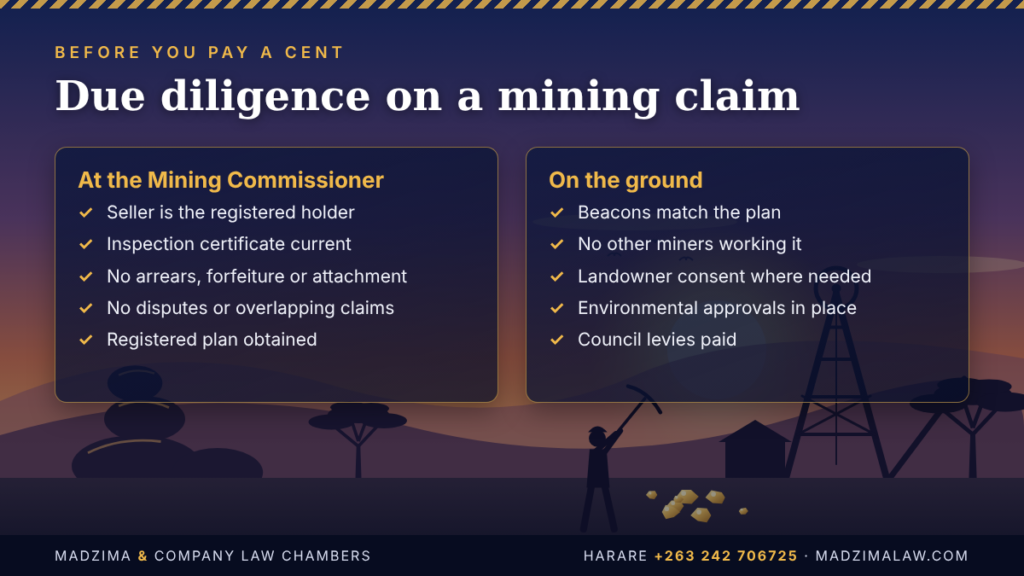 At the Mining Commissioner’s office
- Confirm the registered holder. Search the register for the location by name and registration number. The holder recorded there must be the person, or the company, selling to you. Compare the name and identity number with the seller’s national ID.
- Confirm the location is in good standing. Ask whether the inspection certificate is current and whether any fees, dues or royalties are outstanding. Arrears must be cleared before a transfer can be registered.
- Check for forfeiture, attachment or disputes. Ask specifically whether any forfeiture notice has been issued, whether the location is under judicial attachment, and whether any dispute or overlapping claim has been lodged.
- Obtain the plan. Request the registered plan or coordinates of the location, so that what you inspect on the ground is the ground that is actually registered.
- Check the local authority. Confirm with the Rural District Council that no levies are owed on the location.
On the ground
- Walk the boundaries with the plan in hand. Locate the beacons and pegs and confirm they match the registered coordinates. Note any other miners working on or near the ground.
- Check surface rights. Mining on farmland, near homesteads, cultivated lands, water sources or graves is restricted and may require the consent of the landowner or occupier. A claim that cannot be worked without consent you do not have is a claim of limited value.
- Check the environmental position. Establish whether the operation holds the environmental approvals required by the Environmental Management Agency, and whether there are any orders or outstanding obligations.
About the seller
- If the seller is a company, obtain its registration documents and a board resolution authorising the sale, signed by directors whose names match the company’s records.
- If the registered holder has died, only the duly appointed executor of the estate may sell, and only with letters of administration in hand.
- If you, the buyer, are not a permanent resident of Zimbabwe, note that transfers to persons who are not permanent residents of Zimbabwe are subject to exchange control approval.
III. Red Flags and Common Frauds
The frauds in this sector are not sophisticated. They succeed because buyers are in a hurry. Walk away, or at least stop and take advice, if you encounter any of the following:
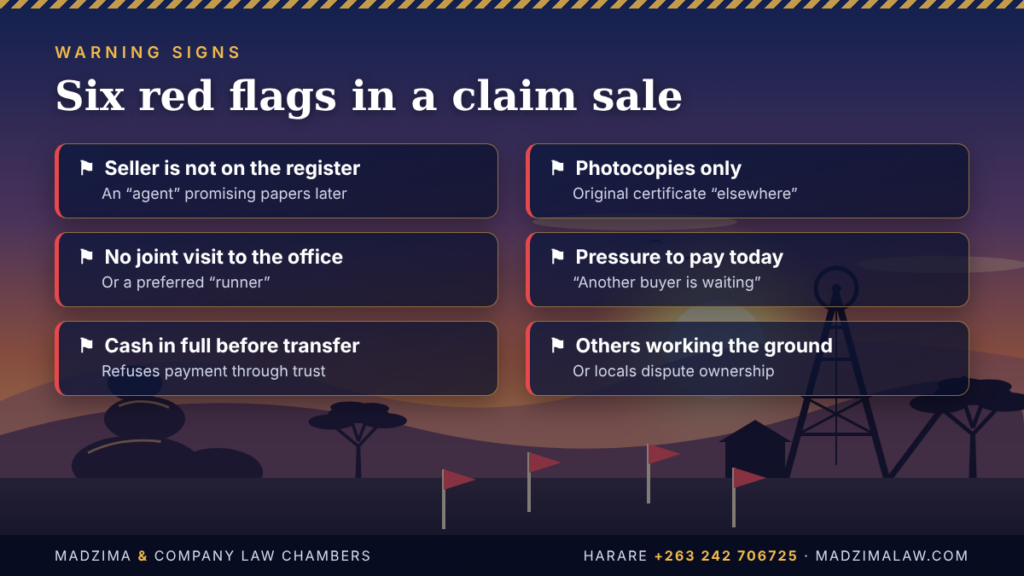 The seller is not the registered holder but an “agent”, relative or “partner” who promises the papers will follow.
- Only a photocopy of the certificate is offered, or the original is “with the bank” or “at the lawyer’s”.
- The seller resists a joint visit to the Mining Commissioner’s office, or insists on a particular official or “runner”.
- Pressure and urgency: another buyer is said to be waiting, or the price is valid “today only”.
- Cash only, and in full, before transfer. Legitimate sellers accept payment through a lawyer’s trust account against registration.
- The price is too good. A productive, compliant claim is rarely sold at a fraction of its value without a reason.
- Other miners on the ground, or local people who say the claim belongs to someone else.
- The certificate details do not match the register, the plan or the beacons on the ground.
The double sale deserves special mention. A seller who receives full payment in cash and never registers the transfer remains, in law, the holder, and is free to sell again. Registration, not payment, is what makes the buyer the owner.
IV. Structuring the Deal
A well-structured purchase ensures that the buyer’s money and the seller’s title move together, so that neither side is left exposed.
A written agreement of sale. Oral deals and one-page “receipts” invite dispute. The agreement should identify the location precisely by name, registration number and mineral; state the price and how it is paid; and contain, at the least:
- warranties that the seller is the registered holder, that the location is in good standing, free of forfeiture, attachment, disputes and arrears, and that all information given is true;
- a suspensive condition that the sale is subject to registration of the transfer by the Mining Commissioner;
- what else is included: equipment, shafts, structures, stockpiles and any employees, each listed;
- an indemnity for liabilities arising before transfer, including environmental and labour claims; and
- a dispute-resolution clause and a clear remedy if the transfer cannot be registered.
Payment through trust. The purchase price should be paid into the trust account of a registered legal practitioner and released to the seller only once the transfer is registered, or in agreed stages tied to verifiable milestones. A buyer who pays the seller directly, in cash and in full, has surrendered his only leverage.
Registration of the transfer. The transaction must be notified to the Mining Commissioner within the period prescribed by the Act, together with the details of the buyer and the consideration. Transfer duty is then paid, and the Mining Commissioner issues a fresh certificate of registration in the buyer’s name. Until that certificate is in the buyer’s hand, the purchase is incomplete.
After transfer. The new holder inherits the obligation to keep the title alive. Diarise the inspection certificate, pay the dues on time, keep proper records of work done, and sell gold only through the lawful channels.
Conclusion
A mining claim can be the foundation of a livelihood, or the grave of one. The difference is seldom the richness of the reef; it is the care taken before the money is paid. Caveat emptor, let the buyer beware, remains good law and better advice. The register is public, the checks are known, and the cost of making them is a fraction of the cost of a dispute.
Madzima & Company Law Chambers acts for buyers and sellers of mining claims: conducting searches at the Mining Commissioner’s office, drafting and negotiating agreements of sale, holding purchase funds in trust, and attending to registration of transfer. Message us on WhatsApp on +263 719 517 400 before you pay.
Chat with the author on WhatsApp
About the author. Changamire T. D. Mukove-Tholanah is a Senior Associate at Madzima & Company Law Chambers, practising in criminal and civil litigation and in mining transactions, with a particular focus on Mashonaland East.
This article provides general information on Zimbabwean law and does not constitute legal advice. Each matter turns on its own facts. For advice on your particular circumstances, consult a registered legal practitioner.
